
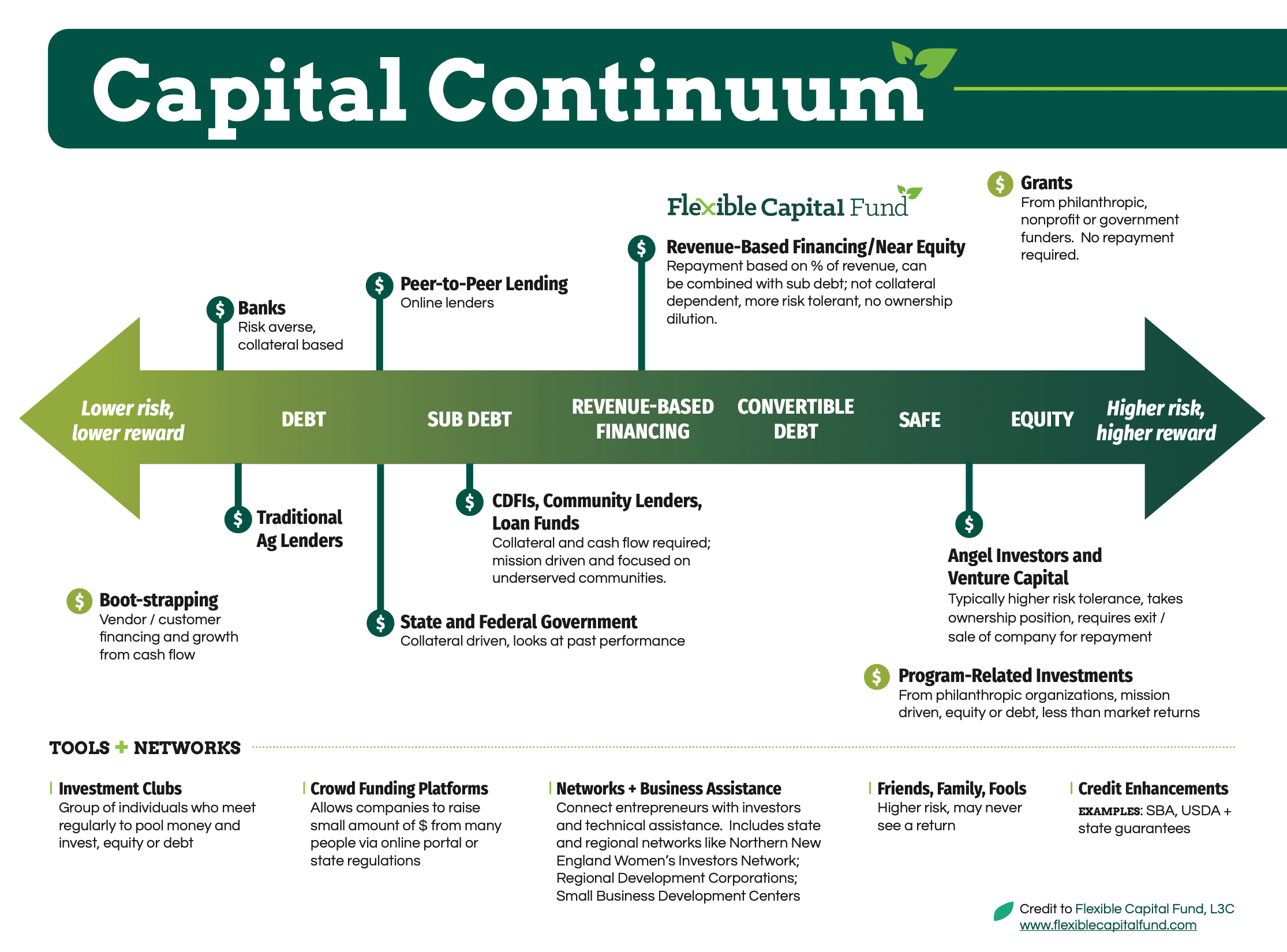
There's more than one way to finance a growing business.
The Capital Continuum illustrates the range of financing tools and types of capital providers that are available to entrepreneurs—from grants and bootstrapping to traditional debt, revenue-based financing, and equity investment.
As you move along the continuum, the risk, cost, expectations, and relationship between an entrepreneur and a capital provider change. Lower-risk forms of capital, such as grants and traditional bank loans, generally offer lower costs but typically require collateral (e.g. equipment or inventory), personal guarantees, or have restrictive covenants.
Higher-risk capital, such as equity, doesn't require a fixed repayment in a certain amount of time, allowing for cash to flow back into a business and accelerate growth. However, equity, by definition, means selling a piece of the company and diluting the founders' ownership. Equity investors may also look to have a decision-making role in the business. Ultimately, the typical way an equity investor (angel or venture capital fund) gets their return on capital invested is from a sale of the business. Traditional equity in the form of venture capital will also seek returns to account for the higher risk — upwards of 5 to 10X their capital invested depending on the company's stage of growth.
Between these traditional sources are flexible financing tools—including subordinated debt, convertible debt, and revenue-based financing—that can fill important gaps when conventional debt financing or higher return equity doesn't fit.
Revenue-based financing, in particular, allows a company to repay a loan based on a percentage of revenue rather than being locked into a set principal and interest payment like a traditional term loan. Once the company pays back a mutually agreed upon multiple on their money borrowed, the loan is paid off. And revenue-based financing does not require an entrepreneur to give up ownership — providing a more flexible, equity-like source of growth capital.
The Capital Continuum also highlights the broader ecosystem of capital provider types that can help entrepreneurs access capital, including CDFIs and community lenders, angel investors, investment networks, crowdfunding platforms, foundations doing program-related investments, donor advised fund holders using philanthropic dollars to invest directly, credit enhancements, and business assistance networks.
Finding the Right Capital for Your Business
The goal isn't simply to find capital—it's to find the right capital.
The right financing can help a business grow all while preserving ownership, flexibility, and company mission. Understanding the Capital Continuum — the tools and types of capital providers — can help entrepreneurs identify where they fit, what options they have, and how different kinds of capital work together.
At the Flexible Capital Fund, we specialize in the space between traditional debt and equity, providing patient, flexible revenue-based financing and other forms of growth capital to businesses that may not fit conventional financing models.
Want to learn more? Our Financing page walks through how revenue-based financing works, our typical investment range and terms, and the criteria we look for in a company. And if you're wondering what this could look like for your own business, we'd welcome the conversation — reach out and let's talk it through.